Welcome to Connext Corner, our ongoing look at what makes Connext® Surgical Matrix different and how surgeons are putting it to work across the operating room. It is where the Ventris team shares the thinking behind Connext, the science, the design decisions, and the real-world situations where it earns a place on the surgical field. This first installment brings the whole story together: what Connext is, why it was built the way it was, and where it fits in complex-wound and surgical-closure cases.
A surgical matrix built for the OR
Connext® Surgical Matrix is a purified, low pH, 100% Type 1 native bovine collagen indicated for the management of complex wounds. It is a second-generation matrix developed specifically for the surgical setting rather than adapted from legacy wound-care technology. Its sub-micron collagen structure is designed to support the body’s natural healing process while providing a highly absorbent matrix that neutralizes wound exudate and forms a protective gel moisture biobarrier over the wound site.
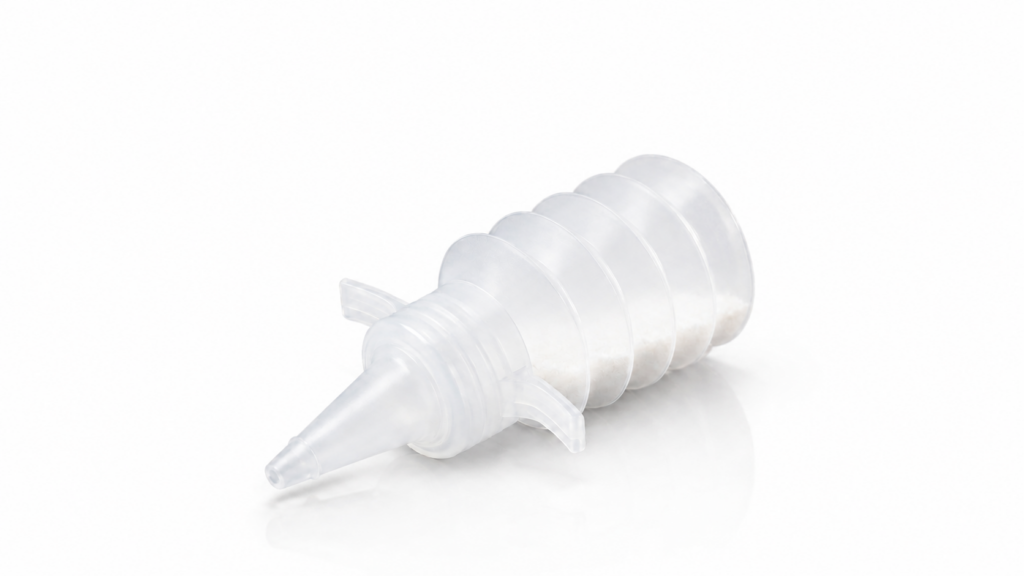
Connext is delivered through a proprietary bellows applicator that provides controlled, ergonomic dispersion of the material with improved reach and precision, designed to optimize handling and surgical efficiency. It is offered in three sizes for precise, controlled delivery, and is designed for single-use surgical wound application, so the team can match the amount of material to the wound, from focused incision lines to larger surgical beds.
Why a second generation matters
Many collagen powders were originally developed for chronic wound care and later carried into the OR. Connext takes the opposite path: it was engineered from the start for surgical wounds, with attention to how the material actually behaves during a procedure. That shows up in practical ways, from a bellows applicator that reaches and doses precisely to a uniform particle size chosen for consistent exudate absorption and a low pH, low endotoxin profile suited to sensitive surgical tissue. The result is a matrix that behaves predictably in the hands of the surgeon and in the wound as it heals and remodels.
What sets Connext apart
Four properties define how Connext performs in the wound.
Low pH collagen. Connext creates a low pH healing environment, which has been shown to increase fibroblast proliferation, support epithelization and angiogenesis, regulate MMP activity, increase oxygenation of damaged tissues, and inhibit the growth of pathogens.
Low endotoxin. Sourced from highly purified bovine Achilles tendon and put through an advanced purification process, Connext minimizes inflammatory responses and is lot tested per USP <85> for use in highly sensitive surgical environments.
Purified 100% Type 1 collagen. Connext facilitates hemostasis, reduces inflammation, and signals cellular migration, proliferation, revascularization, and remodeling, with the goal of minimizing pain and scarring.
Support through healing. A uniform particle size allows for uniform absorption of wound exudate and sustained bioavailability as the wound heals and remodels, while a structural extracellular matrix supports MMP mitigation and remodeling.
Together, these properties make Connext versatile across plastic, reconstructive, and general surgical wounds, and an alternative to close-suction drains, blood vessel ligation, or surgical site immobilization in the prevention of postoperative seromas. Compared with a leading competitor, Connext is distinguished by its bovine Achilles tendon source, its design for surgical wounds, its sustained bioavailability, its occlusive gelatinous substrate, and its low pH and low endotoxin profiles.
In practice, these properties work together. The absorbent, low pH matrix manages exudate and conditions the local wound environment, while the native Type 1 collagen provides a scaffold that supports the cascade of cellular migration, proliferation, and remodeling. Because Connext holds an occlusive, gelatinous substrate over the site, it can also help manage dead space and support closures that might otherwise rely on drains or immobilization.
Where Connext fits across specialties
Because Connext is designed for surgical wounds broadly, its usefulness spans specialties. Here is where surgical teams are finding it most valuable.
Orthopedics and spine. Orthopedic and spine surgery, including both orthopedic spine and neurosurgery, often involve closures where patient comorbidities make healing challenging. Adding Connext gives the surgeon a way to provide the tissue closure with biologic support and an optimized wound environment. Given how much is invested in an orthopedic or spine procedure, supporting the closure is a sensible prophylactic step.
Foot, ankle, and podiatry. These specialties frequently manage patients with at-risk healing driven by comorbidities such as diabetes and risk factors like smoking and obesity. Connext can provide biologic support on surgical incisions and in wounds worked on in the OR, including surgically debrided ulcers, amputations, and dehisced surgical wounds.
Plastic and reconstructive surgery. Plastic surgeons are comfortable using biologic adjuvants to support wound healing, and Connext fits a range of reconstructive and cosmetic procedures: along scar lines and in dead-space management for breast reconstruction, in wound care as a bridge to grafting or under negative pressure, and on Mohs defects and donor sites.
Soft-tissue specialties. Vascular and access, general surgery, gynecologic oncology, urology, and trauma teams are accustomed to biologic support and tend to keep their approach lower on the reconstructive ladder. Across levels one through three, Connext can support post-debridement care, wound closure, bridging to later grafting, and secondary closure. Its native structure fits the nooks, tunnels, and dead space of a wound bed, helping improve wound architecture and, in turn, the cosmesis of the outcome.
The throughline
Across every specialty, the value is the same: Connext delivers biologic support and a sustained, optimized wound environment where surgeons need it most. Whether the goal is a confident closure over a challenging comorbidity or better remodeling in a complex reconstruction, Connext is designed to give the wound a stronger start. In every case, the aim is a closure the surgeon can feel confident about and a wound environment set up to heal and remodel well.
To go deeper on the science, see the research behind Connext on our Medical Citations page, or explore the full details on the Connext® Surgical Matrix product page.